

If your main source of income is benefits, you may still be able to get a loan. Many loan companies consider benefits such as Universal Credit, Child Maintenance Support, and disability living allowance as valid sources of income for a loan.
However, approval depends on the overall affordability, including part-time income, debts, and monthly expenses. The blog discusses eligibility, tips and how individuals living on government-based benefits may qualify for a loan.
So, can you get a loan if you receive government benefits?
Yes, you may get a loan if you receive government benefits. The amounts stay low, and interest rates are competitive. The amount you get depends on the type of benefit you receive and other affordability factors like other income sources, existing debt and monthly expenses.
These factors help the loan company decide whether you can repay the amount with interest. If yes, then you may qualify.
What are loans for people on benefits?
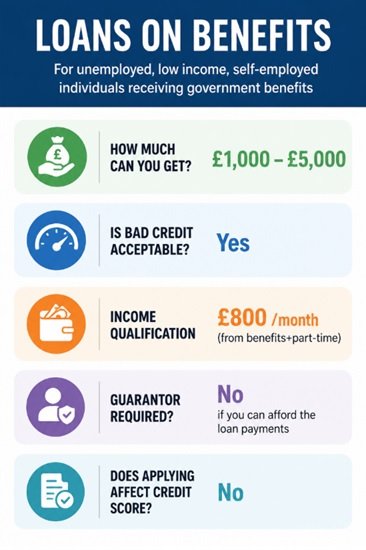
Loans for people on benefits are unsecured loans for individuals receiving government benefits. You may get up to £5000 for 12 months of repayments on loans on benefits from direct lenders. Rather than focusing on past credit mistakes, the loan companies consider current affordability.
The repayments rest on how frequently you receive the benefits. For example, if you receive one monthly, you can repay the dues once the benefits are credited to your account. The interest rates may be competitive but fixed. It helps you make consistent or fixed payments without surprises.
Which benefits count as legal income and which do not for a loan?
Understanding legal benefits that count as income for a loan helps you apply wisely. Here are some benefits that count as income:
| Benefits that count as income for a loan | Benefits that “do not count as income for a loan |
| Working Tax Credit | Housing Benefit |
| Universal credit | Income Support |
| Disability Living Allowance | Job seeker’s Allowance |
| Child Tax Credit | Pension Credits |
| Child Benefit | New Style JSA/ESA |
| Fostering allowance |
Who may be eligible for urgent loans for people living on benefits?
You may be eligible for a loan if you match the following basic qualification criteria:
1. Age and citizenship
You must be 18 and over as a UK citizen to qualify for the loan. Additionally, you must be under State pension age as a full-time resident.
2. Income requirements
You must have a regular income of £800/month (including benefits and other part-time income) to qualify for the loan.
3. Verified residential address
You must have a valid postal address with at least 3 years of consistent proof. If renting, you must be living at the place for at least 6 months to qualify.
4. Have a valid contact and bank account
Identify whether you have an older and consistent contact number you use. Don’t change it or stop it before getting a loan.
Similarly, you must hold a valid bank account number, preferably with a direct debit facility. You should be the valid account holder, and the benefits income should be entered in your name.
5. Clarity on the loan purpose
Understand the purpose for which you are borrowing money. It may help the loan company offer you the right amount, given your affordability.
For example, if you need an urgent loan to pay a bill, mention which bill you want to pay. It could be the electricity bill, water bill or groceries.
6. You must be able to afford payments
Loan companies look at your income, including your benefits, to determine whether you can afford the payments.
No responsible loan company would lend it to you if you cannot repay. If you can manage the loan payments without missing important payments like rent and energy bills, you may qualify.
Do I need to get a guarantor to get loans for people on benefits?
No, you don’t need a guarantor to qualify for loans for people on benefits if you can afford the monthly repayments. It is because the loan amount and the repayment timeline remain small. Alternatively, you may need to provide a guarantor on loans for government benefits if:
- You lack a benefit and part-time income
- You are under deep debt or bankruptcy
- Your benefits payments have not started yet
- You want to borrow a higher amount
How to qualify for loans for benefits on the first attempt?
Here is the simple process to follow to get a loan with government benefits income:
Step 1- Pre-qualify and check the eligibility
Understand which benefits qualify as valid income sources before applying. For example, you may qualify for Child Benefit, Disability Allowance and Universal Credit.
Step 2- Understand the benefits duration
You may struggle to get a loan on benefits income if you are supposed to live on that for over 6 months. Thus, understand when you can get a full-time job opportunity and explore options accordingly.
Step 3: Fix your credit file
Determine the current debts and payments that you have not attended to. Check which of these you can pay now. You can part-pay or pay in full, depending on your comfort.
Note: To qualify, you must be up-to-date with current liabilities like groceries, rent, and other utility payments.
What credit actions may increase the loan approval chances?
- Make consistent payments for 3 months before applying for a loan
- Clear any overdue CCJ or get a “satisfied CCJ” status before applying.
- Remove any unauthorised accounts from the profile (that you don’t know about)
- Register on the electoral roll.
Note: You need to wait for 2-3 months to apply for the loan after making these changes.
Step 4: Provide accurate documents
Arrange and provide accurate documents to get a loan in the UK for your benefit. Here is how it improves the chances of getting a loan:
| Documents required | Impact on approval |
| Proof of Benefits (e.g., Universal Credit, PIP, or DLA or award letters) | If the benefits are stable and accepted as regular income |
| 3 months of recent bank statements | It must show consistent payments and responsible spending. |
| Proof of identity and address (passport, driving license) | It validates your legal status |
Providing correct documents may help you getemergency loans on benefits for needs like car repairs, paying rent, or transportation. Moreover, you get the amount that you can qualify for.
Bottom line
Thus, it is not impossible to get a loan with benefits income in the UK. However, your options will be limited. Identify how much you can repay, given the loan need. You may get the loan if you can afford the loan payments without impacting the budget. Check and explore the hidden charges to avoid surprises later.
FAQs
a. How to borrow responsibly while receiving benefits?
If you receive benefits, consider whether you can afford the extra loan that you borrow. Check whether this loan may impact or put additional financial pressure. Missing a payment may lead to extra interest and loan penalties. Always check the costs before borrowing. Make sure the loan arrangement suits your budget. Avoid borrowing if you can delay the purpose.
b. Will applying for a loan affect my benefits?
No, applying for a loan will not affect your benefits. It will continue to be credited to your bank account. However, if you set up direct debit, the creditor may receive the loan payment directly.
c. What alternatives can I check to get a loan?
You may consider a secured loan if you are a homeowner. It may help you get a higher amount with your home as collateral. Similarly, you may consider a guarantor if you need a larger amount at lower interest rates.
d. Is it possible to get a loan for people on benefits without a credit check?
No, you may not get a loan for people on benefits income without mandatory checks. It showcases how much you can afford on the loan. Thus, no reputable loan company would agree to offer a loan without the basic check. Don’t worry. It does not affect the credit score.
e. What purposes can you apply for a loan for benefits?
You can consider a benefit-based loan to achieve purposes such as rent payments, debt consolidation, household emergencies and appliance repair.