

Usually, self-employed or part-time workers struggle to get a loan. It is due to inconsistent earnings and financial profile. Around 76% of gig workers find it challenging to get a loan, especially a mortgage. It is despite being able to afford the repayments. It thus raises concern: “Can I get a loan as a gig worker in the UK?” Well, the blog explores the possibilities and chances of getting a loan.
Who is a gig worker?
A gig worker is someone who takes up short-term professional projects and jobs. It lasts for 3-6 months, depending on the contract. Thus, income varies as per job type and payment frequency. It is different from any permanently employed individual.
They receive a fixed salary rather than gig workers. Part-time teachers, cab drivers, delivery drivers, writers, graphic designers, and dog walkers are some good examples of gig workers.
Alternatively, gig work also includes zero-hour contract arrangements. This arrangement covers a contract for a fixed term, but not a consistent salary or task availability. They are only paid for the assignments they complete.
Why Do Gig Workers struggle to get a job?
Every loan company uses a rigid criterion to assess a borrower’s affordability. Gig workers with inconsistent income struggle to prove the ability to repay instalments consistently. Thus, most loan companies reject such profiles. Here are other reasons why gig workers face challenges in getting a loan:
1. Documentation difficulties
Loan companies request multiple documents to analyse a gig worker’s ability to repay the loan. It may include aspects like:
- Business plan
- Bank statements
- SA302 tax statements
- Profit and loss statement
- Client list
- Contract history
- Business accounts of the past 2-3 years
Providing every detail about the business can be challenging for the self-employed, especially if they are new to it.
2. Traditional checking models
Usually, lenders prioritise PAYE models when analysing a borrower’s affordability. It includes checking the salary slip, predictable pay cheques, stable employment history, and verifying the employer. However, it becomes difficult to do so in the case of the self-employed. Gig workers just don’t fit the mould and hence struggle to find a loan.
3. Deemed as risky profiles
Most lenders view the self-employed as higher risk because of fluctuating income, gaps in employment, and difficulty verifying long-term stability.
What are gig worker loans?
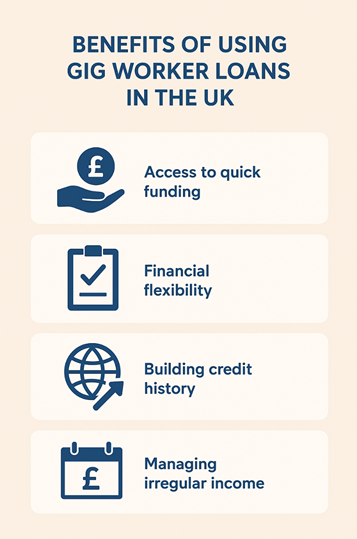
As a part-time worker, self-employed, and contract worker, you could still find a loan. A gig worker loan is a financial facility for individuals with seasonal or inconsistent incomes.
Unlike traditional proofs, such as a salary slip, you may need to provide alternative evidence, like bank statements, payment histories, and self-assessments from gig platforms. The amount you may get depends on the payout, your needs, and your affordability.
When is it more likely to get a loan as a gig worker?
You may qualify for a loan if you can prove your ability to repay it. Here is who is most likely to qualify for a loan as a gig worker:
1. You have well-documented data
Present tax returns, business accounts, consistent bank statements, and a history of contracts. Having the latest proofs of the same may help you get self-employed loans with guaranteed approval. These proofs demonstrate your ability to manage finances and repay loans. A disciplined financial behaviour may help get an edge over the requirements.
2. Contacting the right loan provider
Analyse where you have the highest chances of loan approval. For example, applying to traditional loan companies may not help. Instead, check the ones who specialise in profiles like yours. It increases your chances of getting a loan as a gig worker.
3. Have updated financial profiles
Individuals with a good credit score, income and limited liabilities may qualify for the loan instantly. Sometimes, an old business address, a minor spelling mistake in the business name and unreliable income proofs may affect the loan approval. Thus, check every document and the basic details before applying for the loan.
Can you get a loan for bad credit as a sole trader?
If you have been turned down for the loan application, you may still get the loan for bad credit as a self-employed individual. Business loans for the gig workers may include high interest rates and competitive terms. You can improve the chances of getting a loan as a self-employed with a bad credit score by:
Provide a guarantor
A guarantor is someone with a good credit score, revenue contribution and good personal finance and maintenance. It improves your loan affordability, and you may get a lower interest rate and terms on loans for workers with a bad credit score. It can be your business partner, guardian, or someone you can trust with money matters. However, a guarantor enters or helps you only when you cannot continue the payments individually.
Provide collateral
A collateral could be an asset against which you may get a loan. It may include a business’s vehicle, intellectual property, properties, investments, etc. It could be ideal to provide one if you need a higher amount for your needs (over £50,000).
The loan company analyses the value of the collateral to your requirements. Accordingly, you may get the loan amount. It is flexible enough to meet your needs comfortably.
Provide a larger deposit
It may not be the option every time, but still, you may benefit from this. Check whether the loan company asks for a deposit. If yes, then you can benefit from low interest rates and reduce overall liabilities. Your monthly instalments also fall if you put down a large deposit. It increases your chances of getting a loan approval despite bad credit.
How can I improve my chances of getting a loan as a gig worker?
There are numerous ways to improve your chances of getting a loan as a gig worker. Here is what you can do before applying for the loan:
Build personal and business credit
Identify and pay the pending bills, report delinquencies, use eligibility checkers, update business and personal addresses and details. Avoid applying for multiple loan applications within a short time frame.
Provide comprehensive income proof
Gig worker incomes may fluctuate. Loan providers need extensive documentation to determine your affordability. Here are some aspects to prepare for:
- Ensure bank statements of 3-6 months for business and personal aspects.
- Tax returns of at least 1-2 years (SA302 and tax overview)
- Invoices and contracts to reveal current and future work
- Provide certified accounts if prepared by the accountant.
Build a record of stability
- It is important to ensure stability in your finances by:
- Demonstrate consistent monthly earnings, even if variable
- Showing regular repeat clients or long-term platforms
- Keeping your overdraft usage low
- Maintain a steady residential and official address
Prepare a cash cushion
Many lenders want evidence that you can handle income dips. Try to keep:
- 3-6 months living expenses saved
- A healthy balance in your business account
It reveals responsible financial management.
FAQs
How long do you need to work as a gig worker to get a loan?
You should have at least 12 months of experience to qualify for a loan as a gig worker. However, some loan providers may consider 6-8 months of operating history as well. You need to explore the options for that.
What credit score do I need to get a loan?
There is no fixed credit score to get a loan as a gig worker. However, having a business credit score of 60-80 is usually ideal.
Will having multiple gig jobs help my application?
Yes, more income increases your chances of getting a higher amount and better interest rates. It reveals financial stability and improves your eligibility for the loan.
Bottom line
Thus, you can get a gig worker loan in the UK even as a self-employed person. If you can prove the stability of your income through consistent income, and pay the dues on time, you may get the loan. Try to update the documents, and improve your loan approval chances by providing the latest tax and bank statements.